Why the Best High Arch Support Insoles Are Hard to Find (And How to Choose Right)
The best high arch support insoles are not one-size-fits-all — and if you have high arches, you've probably already figured that out the hard way.
Here's a quick look at the top picks:
| Insole | Best For | Key Feature | Price |
|---|---|---|---|
| PowerStep Pinnacle High | All-day standing & supination | Deep heel cradle, dual-layer cushion | $54.95 |
| Superfeet All-Purpose High Arch | Everyday use | Firm stabilizer cap, sculpted heel cup | $47.99 |
| Superfeet Run Support High Arch | Running & training | EVOLyte carbon fiber, H.I.T. Pod | ~$60+ |
| Superfeet Run Cushion High Arch | Running & zero-drop shoes | Adaptive flex, trim-to-fit | $89.72 |
| Aetrex Orthotics (Fit C) | High arch alignment | Data from 50M+ foot scans | Varies |
High arches — also called pes cavus — put most of your body weight on just two points: your heel and the ball of your foot. That means more pressure, less shock absorption, and a higher chance of your ankle rolling outward (called supination).
The result? Foot fatigue that hits by midday. Sore heels. Tight calves. And a much higher risk of ankle sprains, plantar fasciitis, and stress fractures.
Standard insoles won't cut it here. High arches need firmer, more contoured support with a deep heel cup and targeted cushioning — not just a soft foam pad.
I'm Faisal S. Chughtai, a footwear comfort and performance expert who has spent years helping people find the right fit for their feet — including the best high arch support insoles for long shifts, daily runs, and everything in between. Let's break down exactly what works, and why.

Terms related to best high arch support insoles:
What are High Arches (Pes Cavus) and Why Do They Hurt?
Having "sky-high" arches might sound like a superpower for dancers, but for the rest of us, it can be a literal pain. High arches, or pes cavus, occur when the arch of the foot remains significantly raised even when you are standing and bearing full weight. While flat feet are famous for "collapsing," high arches have the opposite problem: they are often too rigid.
Because the middle of the foot doesn't touch the ground, your body weight isn't distributed evenly. Instead, all that force is slammed into your heel and the ball of your foot (the metatarsal heads). This lack of surface area contact leads to poor shock absorption. Every step you take sends a jar of impact up your legs, which is why people with high arches often complain of knee, hip, and even lower back pain.
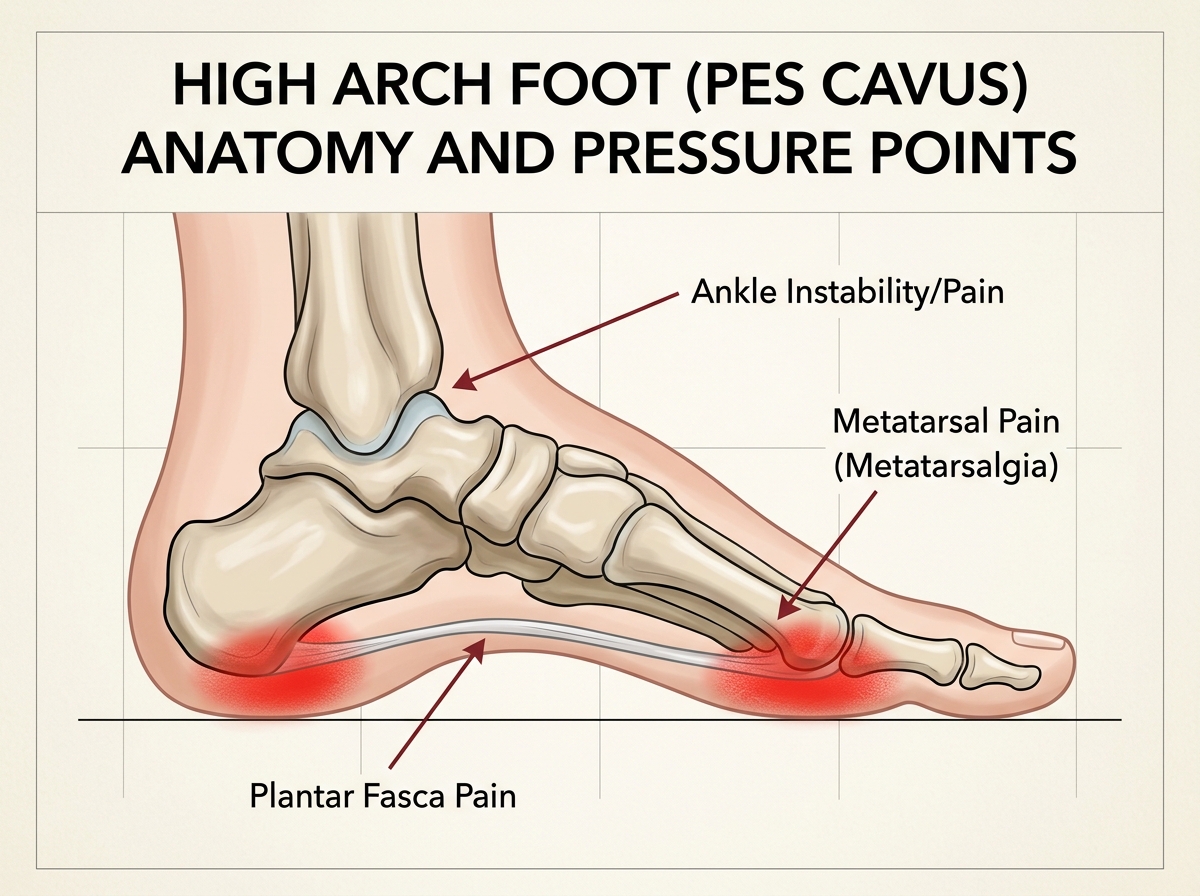
Common issues associated with high arches include:
- Supination (Underpronation): Your feet roll outward, putting excessive pressure on the outer edge of the foot and the smaller toes.
- Ankle Instability: Because you are "perched" on a high arch, your ankles are more prone to rolling, leading to frequent sprains.
- Plantar Fasciitis: The thick band of tissue under your foot stays under constant tension, leading to that dreaded stabbing heel pain.
- Metatarsalgia: Inflammation and pain in the ball of the foot due to excessive pressure.
If you are a nurse, a retail worker, or a runner, these issues are magnified. When we stand or walk for 10+ hours a day, the lack of support causes the muscles in the foot to overwork just to keep us balanced. This is why finding the best high arch support insoles isn't just about comfort—it's about injury prevention.
Key Features of the Best High Arch Support Insoles
When shopping for inserts, you’ll see thousands of "cushioned" options at the drugstore. Avoid the temptation to buy the squishiest ones! For high arches, structure is king. You need an insole that fills the gap between your foot and the shoe to provide "total contact."
The Anatomy of a High Arch Insole
- Firm Arch Support: Unlike flat feet that need a gentle nudge, high arches need a firm, high-profile bridge. This prevents the foot from supination and redistributes weight across the entire foot.
- Deep Heel Cup: This is crucial for stability. A deep cup cradles the fatty pad of your heel, keeping it centered and preventing the outward roll that leads to ankle injuries.
- Targeted Cushioning: Look for high-rebound foams or gel pods at the heel and forefoot. Since these are your primary strike zones, they need extra help absorbing shock.
- Durability: High-quality insoles like Superfeet are designed to last 500 miles or 12 months. Cheaper versions often flatten out within weeks, leaving you unsupported.
| Feature | Firm Support (Best for High Arches) | Cushioned Support (Standard) |
|---|---|---|
| Primary Goal | Structural alignment & stability | Softness & temporary comfort |
| Shock Absorption | High (via deep heel cup & tech) | Moderate (via foam thickness) |
| Durability | Long-lasting (6-12 months) | Short-lived (2-3 months) |
| Best For | Supination, heavy activity, work | Light walking, minor soreness |
Many top-tier brands use advanced materials like EVOLyte carbon fiber for a responsive feel that springs back to shape, or AeroSpring foam for energy transfer. Understanding these features is the first step in our guide to the best arch support shoes and insoles.
Top Recommendations for High Arch Support and Supination
We’ve analyzed the data, consulted podiatrist recommendations, and looked at clinical performance to bring you the top-rated inserts. Whether you're hitting the pavement for a marathon or standing on a hospital floor, these are the gold standards.
Best high arch support insoles for running and high-impact sports
For runners, the insole needs to be dynamic. It shouldn't just sit there; it should help you move.
- Superfeet Run Support High Arch: Formerly known as "Run Comfort," these are a favorite for a reason. They feature a carbon fiber stabilizer cap that provides professional-grade high arch support without adding bulk. The H.I.T. (Heel Impact Technology) pod disperses impact at heel strike, which is a lifesaver for high-arched runners who tend to strike hard.
- Superfeet Run Cushion High Arch: If you prefer a more flexible feel or use zero-drop running shoes, this is your pick. It uses "Adaptive Comfort Technology" to flex with your foot's natural motion while still maintaining that high-profile arch.
Finding the right running insert is all about finding your perfect fit within your specific shoe volume.
Best high arch support insoles for all-day standing and walking
If your day involves more standing than sprinting, you need "total contact" support that reduces fatigue.
- PowerStep Pinnacle High: This is the #1 podiatrist-recommended brand for a reason. It features a uniquely firm shell specifically designed for high arches and supination. The dual-layer cushioning provides a "cloud-like" feel on top of a very rigid support system. It’s perfect for work boots and everyday sneakers.
- Aetrex Orthotics (Fit C): Aetrex uses data from over 50 million foot scans to create anatomically precise shapes. Their "Fit C" models are specifically balanced for high arches, helping to neutralize the foot and prevent the outward roll.
Understanding the difference between arch support for flat feet vs high arches is vital here; while flat feet need to be lifted, high arches need to be "filled in" and stabilized.
How to Determine Your Arch Type and Fit Your Insoles
Not sure if your arches are "sky-high" or just "regular-high"? You can perform a simple assessment at home.
- The Wet Footprint Test: Wet the bottom of your foot and step onto a piece of cardboard or a dark towel. Look at the imprint. If you see your heel and the ball of your foot, but almost nothing connecting them (a very thin line or no line at all), you have high arches.
- The Unweighted Check: Sit down and look at your foot. If the arch looks high while sitting but stays high when you stand up and put weight on it, you have a rigid high arch.
Fitting and Breaking In
Once you've bought the best high arch support insoles, you need to fit them properly. Most high-quality insoles are "trim-to-fit."
- Remove the original liner: Never put your new insole on top of the old one! It creates too much volume and will crush your foot against the top of the shoe.
- Trace and Trim: Use your shoe’s original liner as a template. Trace the toe area onto your new insole and trim with sharp scissors.
- The Break-in Period: Don't wear them for a 12-hour shift on day one. Your feet need time to adjust to the new alignment. Wear them for 1-2 hours the first day, and gradually increase the time over a week. This "step-up" approach is the best way to step-up your game with arch support.
Frequently Asked Questions About High Arch Support
How do I know if I have high arches at home?
Beyond the wet footprint test, look at your shoes. Do they wear out significantly faster on the outer edge of the sole? Do you have a "high instep" (the top of your foot bumps out, making it hard to fit into tight loafers)? These are classic signs of a high arch foot profile.
Can insoles help with supination (underpronation)?
Absolutely. Supination is the outward rolling of the foot, which is the hallmark of high arches. By using an insole with a deep heel cradle and a firm arch, you "lock" the heel into a neutral position. This prevents the ankle from tilting outward, reducing the risk of chronic ankle sprains and outer-foot pain.
Should I choose firm or cushioned insoles for high arches?
Expert consensus—and our own testing—points toward firm support. While a soft gel insole feels good for the first five minutes, it doesn't provide the structural integrity needed to redistribute pressure. A firm insole maintains the arch's shape under the pressure of your body weight, which is what actually reduces fatigue and prevents injury over a long day.
Conclusion
At On Clouder, we believe that your feet are the foundation of your entire day. If you have high arches, you are more susceptible to pain, but you don't have to live with it. By choosing the best high arch support insoles—ones that offer firm structure, deep heel cups, and podiatrist-approved designs—you can transform your favorite shoes into a custom-feeling support system.
Whether you choose the carbon-fiber tech of Superfeet or the clinically proven relief of PowerStep, the key is to stop settling for standard foam and start giving your arches the bridge they need. Ready to upgrade your footwear? Find the best arch support for runners and walkers alike in our deep-dive guides. Your feet will thank you!



0 Comments